-
 Nami Team
-
 30 July 2026
-
 Technology news
Best Mobile App Design Company in Saudi Arabia | Professional Mobile App Development
Choosing the best mobile app design company in Saudi Arabia has become an essential step for businesses and entrepreneurs seeking to enter the digital market, develop their services, and reach customers more easily and effectively. As reliance on smartphones continues to grow, mobile applications are no longer just an additional communication channel. They have become an important tool for supporting sales, improving user experience, and developing business operations.
The success of any application depends on several factors, including design quality, programming efficiency, choosing the right technologies, ease of use, security, and post-launch maintenance. Therefore, choosing a company specializing in mobile app design and development helps transform an idea into a digital product that meets users’ needs and supports business objectives.
In this article, we will explore the key criteria for choosing a mobile app design company in Saudi Arabia, the services provided by Nami, backed by more than 9 years of experience in the field, the latest mobile app development technologies, application development costs, and the key factors that contribute to success, along with examples of Nami’s mobile app projects.
Best Mobile App Design Company in Saudi Arabia
Choosing the right mobile app design company starts with identifying the project’s needs, then evaluating the company’s experience and ability to implement the required features within a clear budget and timeline. Price and visual design alone are not enough; the quality of execution and the services provided before and after launch must also be considered.
The most important criteria for choosing a mobile app development company include:
-
Practical experience in app development: Experience helps the team understand technical challenges and identify solutions that suit the nature of the project.
-
Portfolio and previous projects: Reviewing completed applications provides insight into the company’s design and programming quality and the range of solutions it offers.
-
A specialized design and development team: Collaboration between designers and developers helps create an application that combines practical functionality with ease of use.
-
Choosing the right technologies: The technology used should align with the application’s requirements, expected performance, and future scalability.
-
A clear work plan: Defining project stages, features, and delivery dates helps track progress and reduce differences in expectations.
-
Testing before launch: Testing helps identify and resolve issues before the application reaches users.
-
Maintenance and technical support: It is important to understand how the application will be updated and technical issues addressed after launch.
-
Value for money: Prices should be compared based on the scope of work, execution quality, and included services—not simply the lowest price.
Nami is considered one of the leading mobile app design and development companies serving the Saudi market. It provides solutions for developing Android and iOS applications, focusing on performance, user experience, and integration with other systems according to each project’s needs and objectives. Learn more about Nami’s mobile application development services.
Mobile App Design and Development Services
Mobile app design and development involve several stages, beginning with evaluating the idea, continuing through interface design and feature development, and ending with testing, launch, and maintenance. Completing these stages according to a clear plan helps reduce problems and improve the quality of the final product.
The main services offered by mobile app development companies include:
-
App idea analysis: Defining the application’s purpose, target audience, and the problem it aims to solve.
-
Feature and functionality planning: Identifying pages, screens, user journeys, and essential features.
-
User interface (UI) design: Creating screens and visual elements that align with the project’s identity.
-
User experience (UX) design: Organizing user journeys to make services easier to access and tasks simpler to complete.
-
Android and iOS app development: Developing applications for the targeted operating systems and devices.
-
Admin dashboard development: Providing an administrative interface for managing users, content, orders, and data according to the project’s needs.
-
Integration with external systems: Connecting the application to payment gateways, maps, messaging services, and administrative systems.
-
Application testing and quality assurance: Reviewing functionality, compatibility, and performance before launch.
-
Maintenance and updates: Resolving issues, improving performance, and developing features as agreed.
Some projects may require only a selection of these services, while larger applications need an integrated scope covering planning, design, programming, and deployment. Therefore, requirements should be clearly defined before requesting a price quotation.
Types of Mobile Applications Most in Demand in Saudi Arabia
Mobile applications vary according to the nature of a business and its customers’ needs. As digital services expand across Saudi Arabia, applications have become an effective way for businesses to simplify transactions, improve service delivery, and reach different groups of users.
The most common types of mobile applications include:
-
E-commerce applications: These allow businesses to display products, manage orders, simplify online shopping and payments, and enable customers to track order status. One example of Nami’s work is the Abu Batal Livestock application, which allows customers to purchase livestock and choose their preferred cutting and preparation options.
-
Delivery applications: These connect customers with service providers or stores and help manage, deliver, and track orders. One example is the Mishwar application, which provides delivery and transportation services.
-
Transportation and shipping applications: These support transportation requests, trip and shipment management, and communication between customers and service providers. You can explore the Shohnatk application, which is designed to simplify the transportation and shipping of goods and personal belongings.
-
Appointment booking applications: These are suitable for clinics, beauty centers, and service businesses. They help organize appointments and send reminders.
-
Medical applications: These may provide appointment booking, digital consultations, and selected health information management services, in accordance with applicable requirements and regulations.
-
Educational applications: These provide courses, educational content, assessments, and tools for tracking learners’ progress.
-
Real estate applications: These allow users to browse properties, compare options, and communicate with owners or brokers. One example is the Almanasah Alaqaria application, which supports property sales, purchases, rentals, and property management.
-
Financial applications: These may include account management, payments, or digital financial services, depending on licensing and regulatory requirements.
-
Home services applications: These make it easier to request maintenance, cleaning, and professional services and track requests. An example of Nami’s work is the Elragy application, which provides maintenance services for homes and businesses.
Choosing an application type should not be based solely on how popular an idea is. Businesses should study their target audience, service usage patterns, competitors, and budget. They should also identify the essential features for the first release, then add further functionality according to user needs and usage results.
Essential Features of Professional Mobile Applications
A professional mobile application needs to combine useful functionality, clear design, and reliable performance. The easier it is for users to find what they need, the greater the likelihood that they will be satisfied with the service and continue using it.
The most important features to consider include:
-
Fast performance: Screens should load quickly, and operations should be completed without unnecessary delays.
-
Ease of use: Menus and buttons should be organized, and the steps required to complete tasks should be simple.
-
Consistent design: Colors, fonts, and visual elements should align with the brand identity.
-
Data protection: Appropriate controls should be implemented to protect information and manage access permissions.
-
Push notifications: Notifications can be sent about orders, bookings, or updates when needed.
-
Payment integration: Suitable and secure payment options should be provided when the application involves financial transactions.
-
Practical admin dashboard: Content, users, orders, and reports should be easy to manage.
-
Device compatibility: The application should be tested on the targeted devices and operating system versions.
-
Scalability: The application architecture should support adding new features as the business grows.
-
Usage analytics: Relevant data can be used to understand user behavior and improve the application while respecting privacy.
Priorities vary from one application to another. A delivery application needs order and location management, while an e-commerce store requires product, inventory, and payment management. Features should therefore be selected according to the application’s actual functions rather than adding options that provide no clear value.
Latest Mobile App Development Technologies
The technology used to develop a mobile application affects how it is built, its performance, maintenance costs, and its ability to evolve in the future. No single technology is suitable for every project; the right choice depends on the application’s requirements, budget, and functionality.
Some of the most widely used technologies for mobile app development include:
-
Flutter: A framework developed by Google that enables developers to build Android and iOS applications using a shared codebase in many cases. This can help streamline development and reduce duplicated work.
-
React Native: A framework based on JavaScript and React that supports cross-platform application development while allowing the use of native components when needed.
-
Swift: A programming language used to develop applications for Apple platforms, including iOS. It is suitable for projects that need to take advantage of system capabilities.
-
Kotlin: A modern programming language widely used for Android application development.
-
Laravel: A PHP framework that can be used to build backend systems, APIs, and databases that support mobile applications.
-
Node.js: A JavaScript runtime environment that can be used to build backend services and application programming interfaces.
Application success does not depend on technology alone. It also requires suitable design, well-organized code, effective testing, and a technical architecture that matches expected usage levels. The availability of developers and the expertise needed for long-term maintenance and development should also be considered.
Criteria for Choosing the Right Technology for App Development
Choosing the right technology requires studying the application’s nature and objectives before programming begins. A technology suitable for a simple online store may not be the best option for an application that processes large amounts of data or requires complex technical integrations.
The most important selection criteria include:
-
Application type and functionality: Requirements differ between shopping, delivery, booking, and specialized applications.
-
Target operating systems: Determine whether the application will run on Android, iOS, or both.
-
Expected number of users: Usage estimates help determine performance and backend infrastructure requirements.
-
Available budget: Balance initial development costs with operating and maintenance expenses.
-
Development speed: Cross-platform technologies may allow code sharing between operating systems, depending on the project.
-
Performance requirements: Some applications require rapid responses or deep integration with device features.
-
Future scalability: Choose an architecture that can support increasing user numbers and additional features.
-
Ease of maintenance: The availability of experienced developers and suitable tools affects the project’s long-term sustainability.
Early technical planning helps reduce costly changes during development. Businesses can benefit from Nami’s technical consulting services to assess project needs, compare technology options, and identify suitable solutions before development begins.
Mobile App Design and Development Costs in Saudi Arabia
Mobile app development costs in Saudi Arabia vary depending on project size, the number of features, the level of customization, and the technologies used. There is no fixed price that applies to every application, so the project scope must be defined before requesting an accurate quotation.
As a general estimate, development costs may fall within the following ranges:
-
Simple application: SAR 10,000–25,000.
-
Medium-sized application: SAR 25,000–60,000.
-
Advanced or complex application: SAR 60,000–150,000 or more.
These ranges are estimates, not standardized prices for the Saudi market. Actual costs may vary significantly depending on project requirements and the development company. Current prices should be confirmed when requesting a quotation, as costs change according to scope and customization.
The main factors affecting mobile app development costs include:
-
The number of screens and required features.
-
Custom interface design and the complexity of the user experience.
-
Whether the application is developed for one operating system or both Android and iOS.
-
The development of an admin dashboard, database, and user management system.
-
Integration with payment gateways, maps, and external systems.
-
Security and data protection requirements.
-
Testing and quality assurance before launch.
-
Hosting, external services, maintenance, and technical support.
For a more accurate estimate, prepare a clear description of the application idea, its essential features, and its target audience. Then compare quotations based on deliverables and included services rather than price alone.
The Importance of User Experience (UX) in Mobile App Success
User experience affects how easily people can use an application and complete the tasks they need. An application that confuses users or requires too many steps to complete a simple action may experience lower engagement and a higher likelihood of users leaving.
A good user experience helps to:
-
Make navigation between screens and access to essential features easier.
-
Reduce the steps required to complete a purchase, booking, or request.
-
Present information and instructions clearly.
-
Improve customer satisfaction.
-
Support engagement and continued application usage.
-
Reduce errors caused by poorly organized interfaces.
-
Strengthen trust in the brand.
Improving user experience begins with understanding the target audience, identifying key user journeys, and then designing, testing, and refining screens based on feedback. This process may include testing prototypes before completing programming, reducing the need for major changes in later stages.
Good user experience complements programming quality. A successful application needs functions that work correctly and interfaces that help users benefit from them easily. Therefore, Nami’s UI/UX design services are an important part of developing mobile applications that are easy to use and meet customers’ needs.
The Importance of Mobile App Maintenance and Updates After Launch
App development does not end when an application is published. It may require security updates, performance improvements, and compatibility updates for new operating system versions. Additional needs may also emerge after real users begin using the application and providing feedback.
Mobile app maintenance typically includes:
-
Technical bug fixes: Resolving problems that arise during use.
-
Security updates: Reviewing components and permissions and addressing vulnerabilities when discovered.
-
Performance optimization: Reviewing loading speed, resource consumption, and responsiveness.
-
Operating system compatibility: Updating the application when needed to support targeted devices and operating system versions.
-
Feature development: Adding new functions according to project needs.
-
Integration reviews: Ensuring that payment services, maps, and external systems continue to work correctly.
-
User feedback monitoring: Using problems and suggestions to determine improvement priorities.
It is important to agree in advance on the scope of maintenance, support duration, issue reporting process, response times, and any additional costs. This helps keep the application stable after launch.
With Nami, our relationship with your project does not end at delivery and launch. We aim to continue supporting you through technical support after the application has been launched and delivered, helping address technical issues and maintain application stability.
Common Mistakes That Lead to Mobile App Failure
Some applications struggle to attract or retain users because of planning, design, or implementation mistakes. These risks can be reduced by researching the idea, defining requirements, and testing the application before release.
Common mistakes to avoid include:
-
Failing to research the project idea: Ignoring audience needs and competitors may result in an application that offers no clear value.
-
Adding unnecessary features: Irrelevant features increase complexity and cost without improving the user experience.
-
Designing complicated interfaces: Unclear interfaces can make tasks difficult to complete.
-
Neglecting performance: Slow loading or repeated crashes can frustrate users.
-
Weak data protection: Inadequate security may expose information and users to risks.
-
Ignoring testing: This can result in an application being released with functional or compatibility issues.
-
Failing to plan operating costs: Overlooking hosting, maintenance, and external service costs may create financial pressure later.
-
Neglecting updates: This can cause compatibility or performance issues over time.
-
Choosing a company without reviewing its work: This may lead to a gap between expectations and actual delivery capabilities.
-
Failing to define the scope of work clearly: This can lead to disagreements over features, changes, and delivery dates.
Good planning, documented requirements, phased testing, and continuous communication with the development team are important steps toward reducing these mistakes and improving the project’s chances of success.
How Long Does It Take to Develop a Mobile App in Saudi Arabia?
The time required to develop a mobile application depends on the project’s size, number of features, design complexity, and required integrations. The timeline is also affected by how quickly designs are approved, whether content and data are available, and how clearly requirements are defined from the beginning.
As a general estimate, development may take:
-
Simple application: 4–8 weeks.
-
Medium-sized application: 2–4 months.
-
Advanced or complex application: 4–8 months or more.
These timeframes are estimates, not guarantees. An application may take longer if it includes specialized functionality, multiple integrations, or additional regulatory requirements.
Factors affecting development time include:
-
The number of screens and features.
-
The level of design and programming customization.
-
Technology selection and the development approach.
-
Backend systems and admin dashboards.
-
Integration with external services.
-
The number of review and revision cycles.
-
Testing time and issue resolution before launch.
It is best to divide the project into clear stages, defining the deliverables and responsibilities of both the client and development team. This makes progress easier to track and helps identify changes to the timeline.
Mobile App Development for Android and iOS
Mobile app development begins by identifying the operating systems used by the target audience. Some projects may initially require an application for only one operating system, while others need to reach both Android and iOS users.
The main development options include:
-
Android app development: Suitable for projects targeting users of Android devices, with specific devices and operating system versions identified for support.
-
iOS app development: Targets Apple device users and must account for system requirements, user experience, and publishing policies.
-
Cross-platform app development: Technologies such as Flutter and React Native can be used to build applications for both platforms while sharing code where appropriate.
The choice depends on budget, performance requirements, functions that need to integrate with the device, and future maintenance needs. The application should also be tested on targeted devices to ensure that its core functions work correctly.
Developing a cross-platform application does not mean that the same solution is suitable for every project. Some applications benefit from a shared codebase, while others require customized development to meet specific technical requirements.
Mobile App Development with Nami to Achieve Business Goals
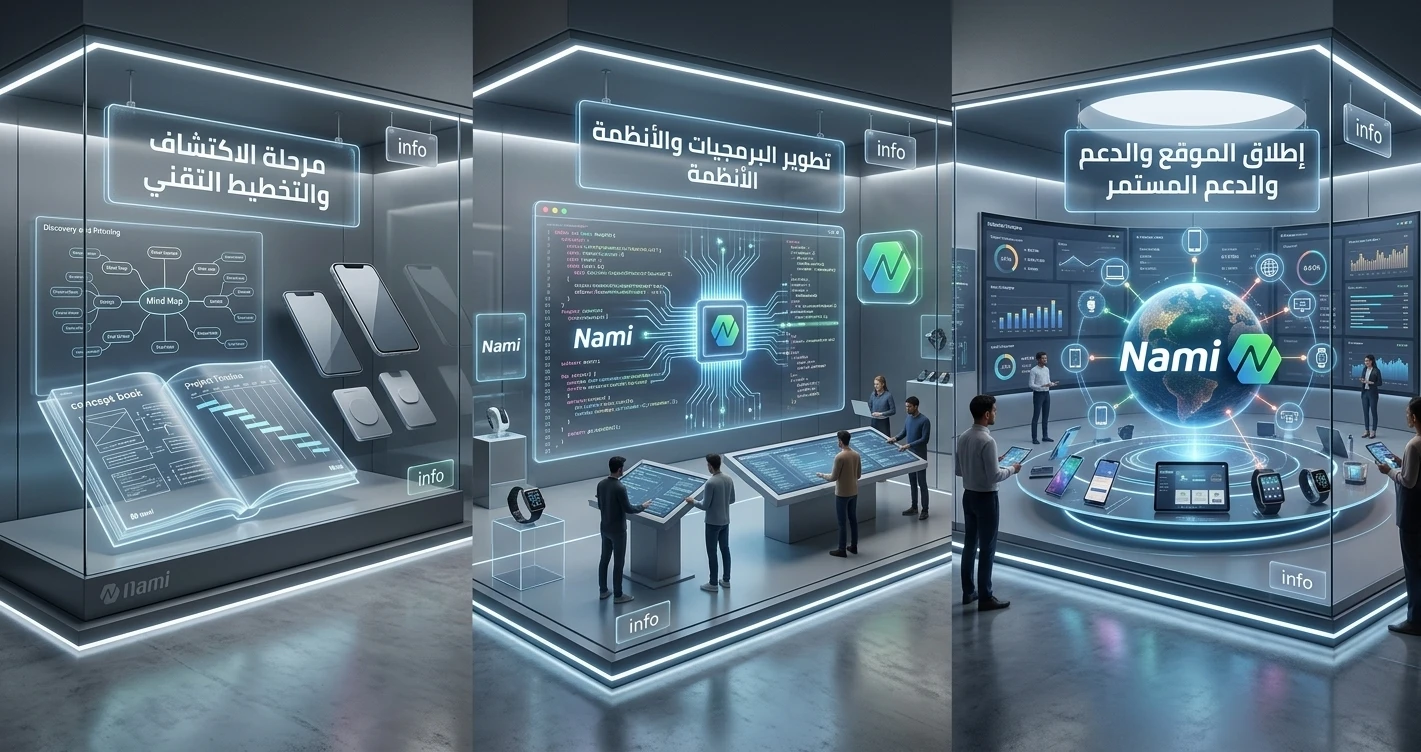
Nami helps businesses turn ideas into mobile applications through a work methodology that begins with understanding project objectives, then defining requirements, designing, developing, and testing the application before launch and support according to the agreed scope of work.
With more than 9 years of experience in the field, Nami focuses on providing digital solutions that suit each business and its users’ needs. The work methodology includes several stages:
-
Project idea analysis: Studying business objectives, user needs, and required functionality.
-
Defining the application scope: Prioritizing features and identifying essential functions and capabilities that can be developed later.
-
User interface and experience design: Creating clear screens and user journeys suited to the target audience.
-
Selecting the right technology: Choosing the framework and technical architecture according to performance and scalability requirements.
-
Programming and integration: Implementing functionality and connecting the application to the required services and systems.
-
Pre-launch testing: Reviewing functionality, performance, and compatibility and resolving identified issues.
-
Support and development: Addressing the application’s post-launch needs according to the maintenance and support agreement.
Interface design is an important part of this process, helping create visual elements that reflect the project’s identity while maintaining clarity and ease of use.
Examples of Mobile Applications Developed by Nami
Reviewing previous work helps businesses understand the types of projects a company has completed and the range of functions mobile applications may require. Examples of Nami’s projects include:
-
Sale Gates: An e-commerce marketplace that brings individuals, businesses, and showroom owners together to display products and services and buy and sell online.
-
Mori: A delivery and transportation application that allows users to order food and groceries and send shipments.
-
Meshwar: An application providing delivery and transportation services to make accessing services easier.
-
Home Fix: An application that helps users request home maintenance services digitally.
These examples demonstrate how application requirements vary by industry. An e-commerce application needs product and order management, while a delivery application requires features for order handling and tracking. A maintenance application may need service management and connections between customers and service providers.
Explore Nami’s portfolio to discover examples of completed digital projects and compare solutions according to the nature and requirements of each project.
Supporting App Growth Through Digital Marketing
An application’s success does not depend on programming alone. It also depends on how effectively the business introduces the application to its audience, reaches suitable users, and improves its digital presence according to business objectives.
Suitable marketing plans may include:
-
Improving content and visibility in relevant search results.
-
Creating content that explains the application’s value and how to use it.
-
Managing advertising campaigns according to the target audience and budget.
-
Using appropriate communication channels to promote the service.
-
Monitoring performance and engagement metrics and using the results to improve campaigns.
Nami’s digital marketing services can help businesses reach their target audiences. Marketing activities should be selected according to the application’s nature, objectives, and available budget.
Start Developing Your App with Nami
A successful application begins with a clear idea, an understanding of the target audience, and a development plan that defines essential features, budget, and timeline. Choosing a specialized company helps organize the work stages and transform the idea into a digital solution that can be used and developed over time.
Before starting your project, make sure to define:
-
The application’s primary objective.
-
The target audience and its needs.
-
The essential features the application must provide.
-
The operating systems and devices to support.
-
The expected budget and timeline.
-
Maintenance and support requirements after launch.
If you are planning to launch a new application or improve an existing one, you can contact Nami’s team to discuss your project idea, identify its requirements, and explore technical solutions that suit your objectives.
Choosing the right mobile app development company is not just about building an application that works. It is about developing a digital product that serves users and supports business goals, backed by a clear plan for operation, improvement, and future growth.
Share :